
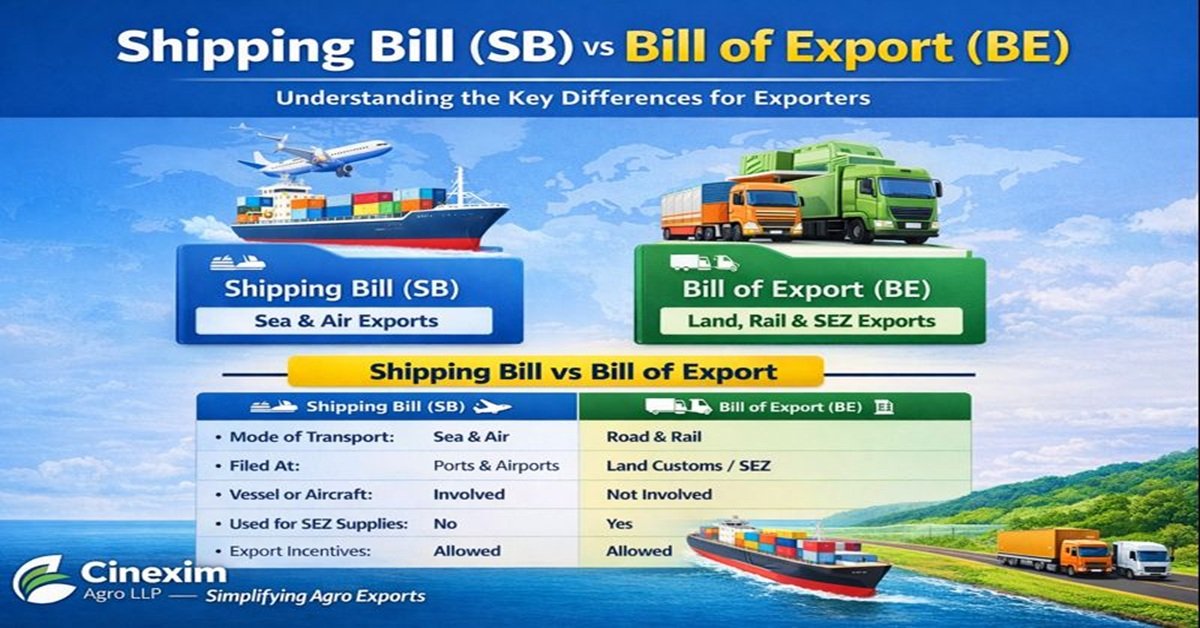
Shipping Bill (SB) vs Bill of Export (BE): A Simple Guide for New Exporters
In international trade, documentation is just as important as the quality of goods being exported. Even if an exporter has a confirmed overseas buyer and ready stock, the shipment cannot move without proper customs approval. Two of the most important export documents used in India are the Shipping Bill (SB) and the Bill of Export (BE). These documents act as legal permission from Customs and serve as proof that goods are being exported from India.
At Cinexim Agro LLP, we regularly work with agri and food exporters, including first-time exporters and MSMEs. One common confusion we see is between Shipping Bill and Bill of Export. Though both are export documents, they are used in different situations, mainly depending on how and from where the goods are exported. Understanding this difference is essential to avoid delays, compliance issues, and loss of export benefits.
What is a Shipping Bill (SB)?
A Shipping Bill is a mandatory customs document used when goods are exported from India by sea or by air. It is filed with Indian Customs at seaports and airports before goods are allowed to be loaded onto a ship or aircraft. Without a Shipping Bill, Customs will not permit export of the goods.
The Shipping Bill contains details such as exporter name, IEC number, buyer information, description of goods, HS code, FOB value, destination country, and export benefit details if applicable. After customs verification and examination, export permission is granted. The Shipping Bill is also essential for claiming export incentives such as Duty Drawback or RoDTEP.
In simple terms, whenever goods are exported through a port or airport, a Shipping Bill is required.
What is a Bill of Export (BE)?
A Bill of Export is used when goods are exported by road or rail, or when goods are supplied from the Domestic Tariff Area (DTA) to a Special Economic Zone (SEZ). Since there is no ship or aircraft involved in such movements, the document is called a Bill of Export instead of a Shipping Bill.
The Bill of Export includes exporter details, product information, value, HS code, and incentive details similar to a Shipping Bill. It is filed electronically at Land Customs Stations or SEZ customs offices. Once customs clearance is granted, goods are allowed to move across land borders or into SEZs.
Exports to neighboring countries such as Nepal or Bhutan by road, exports to Bangladesh by rail, and supplies made to SEZ units all require a Bill of Export.
Short Explanation of DTA (Domestic Tariff Area)
Domestic Tariff Area (DTA) refers to the normal area within India where goods are manufactured, sold, and consumed, and where regular customs duties and GST apply. Most factories, farms, warehouses, and businesses in India fall under DTA.
When goods move from DTA to a foreign country, it is considered an export. Similarly, when goods move from DTA to an SEZ unit, it is also treated as an export for customs and tax purposes. This is why a Bill of Export is required for DTA to SEZ supplies.
Short Explanation of SEZ (Special Economic Zone)
A Special Economic Zone (SEZ) is a specially notified area in India created to promote exports. SEZs are treated as foreign territory for trade and taxation purposes, even though they are located within India. Businesses operating in SEZs enjoy various benefits such as tax incentives, simplified procedures, and duty-free imports.
When goods are supplied from DTA to an SEZ unit, it is considered an export, and customs clearance is required. For this movement, exporters must file a Bill of Export, not a Shipping Bill.
Importance of Shipping Bill and Bill of Export
Both Shipping Bill and Bill of Export act as legal authorization for exports. They are required for customs clearance, claiming export incentives, GST refunds, and meeting banking and regulatory requirements. Filing the wrong document or incorrect details can lead to shipment delays, penalties, or rejection of benefits.
At Cinexim Agro LLP, we always advise exporters to clearly identify the mode of transport and destination before filing export documents.

Types and Incentives Linked to SB and BE
Both Shipping Bill and Bill of Export can be filed under different categories depending on whether export incentives are claimed. These include free exports, duty drawback, RoDTEP, Advance Authorisation, and EPCG. Earlier, physical documents were identified by different colors, but today most filings are electronic and incentives are linked digitally in the customs system.
Conclusion
Shipping Bill and Bill of Export are two essential export documents that serve the same purpose but are used in different export scenarios. The Shipping Bill is required for exports by sea and air, while the Bill of Export is used for exports by road, rail, and supplies to SEZs. Understanding this difference is especially important for new exporters and MSMEs.
At Cinexim Agro LLP, we believe that clear understanding of export documentation is the first step toward building a successful and compliant export business. Correct documentation ensures smooth customs clearance, timely shipments, and full benefit of government export incentives.