
APEDA and FSSAI License Holders: Understanding Their Role in Herbal and Nutraceutical Exports
The global market for wellness, herbal, and nutraceutical products is expanding rapidly. Consumers worldwide are becoming more health-conscious and are increasingly choosing plant-based, food-grade, and natural nutrition products over synthetic alternatives. This shift has created strong export opportunities for India, a country rich in agricultural resources and traditional botanical knowledge.
In this growing ecosystem, businesses holding APEDA and FSSAI licenses play a vital but often misunderstood role. While these license holders are not pharmaceutical manufacturers, they act as important enablers in India’s wellness and nutraceutical export value chain, especially where agriculture and food safety intersect.
The Role of APEDA in Wellness and Herbal Exports
APEDA (Agricultural and Processed Food Products Export Development Authority) is responsible for promoting the export of agricultural and processed food products from India. For exporters, APEDA registration provides market access support, export promotion benefits, and guidance on international trade requirements.
In the context of herbal and nutraceutical exports, APEDA is relevant wherever products are agriculture-based or plant-derived. This includes herbal raw materials, processed botanical products, superfoods, and value-added food-grade wellness items. APEDA does not regulate medicines, but it plays a key role in supporting the export of agri-linked wellness products to global markets.
Why FSSAI Is Central to Nutraceutical and Functional Food Products
The Food Safety and Standards Authority of India (FSSAI) regulates all food products, including nutraceuticals and functional foods, as long as they do not make medicinal or curative claims. Nutraceuticals are legally treated as food, not drugs, when they are positioned for general health and nutrition.
For exporters, an FSSAI license ensures that products meet Indian food safety standards and are suitable for international markets. When combined with APEDA registration, FSSAI licensing allows businesses to confidently operate in the global wellness and nutrition segment without entering pharmaceutical or AYUSH regulatory territory.
Product Scope Explained Through the Visual Table

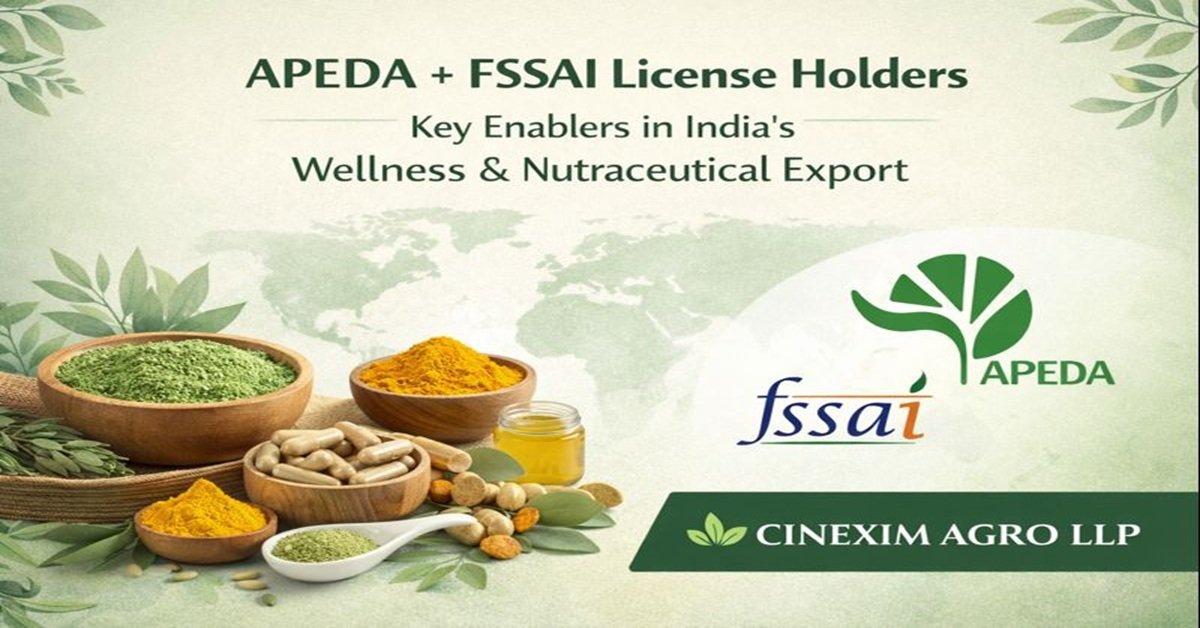
“Explore the Export Potential: Herbal, Nutraceutical, and Wellness Products
APEDA + FSSAI License Holders Can Trade – Featuring Cinexim Agro LLP”
The accompanying image in this article clearly explains the product scope for APEDA + FSSAI license holders in the herbal and nutraceutical export niche. It visually categorises products based on their type, regulatory status, and export use case, making it easier for readers to understand what is legally permissible.
As shown in the table, APEDA and FSSAI license holders can engage in the export of nutraceuticals and functional foods such as plant-based protein powders, vitamin and mineral food supplements, fortified foods, and immunity-support blends. These products are widely accepted in international markets and are regulated strictly as food products.
The image also highlights herbal nutrition powders and superfoods, including turmeric, moringa, amla, spirulina, chia seeds, flaxseeds, and psyllium husk. These products are derived directly from agriculture and enjoy strong global demand due to their natural and preventive health appeal.
Another important category shown in the table is herbal teas, botanical ingredients, and processed herbal foods, such as herbal drink mixes and nutrition bars. These value-added products allow exporters to move up the value chain while remaining within the food regulatory framework.
Finally, the table clearly outlines the role of APEDA and FSSAI exporters as B2B suppliers of herbal raw materials and natural wellness ingredients. Dried herbs, roots, flowers, food-grade extracts, curcumin, and plant fibres are commonly exported as ingredients to international nutraceutical and wellness brands.
Clear Regulatory Boundary with Pharmaceuticals and AYUSH
A key message reinforced by the image and this article is the importance of regulatory boundaries. APEDA and FSSAI license holders cannot manufacture or export pharmaceutical drugs, nor can they market products with claims related to curing, treating, or preventing diseases. Such products fall under AYUSH or drug regulatory authorities and require separate approvals.
This clarity protects exporters from regulatory risks and helps them focus on a segment that is high-growth, export-friendly, and policy-aligned.
Strategic Importance of This Niche for India
The wellness and nutraceutical export segment allows India to combine agricultural strength, food processing capabilities, and global health trends. APEDA and FSSAI license holders form the backbone of this model by converting farm-level produce into compliant, value-added wellness products for international markets.
This approach supports farmers, encourages value addition, and aligns with government objectives related to export growth and sustainable agriculture-based industries.
Cinexim Agro LLP and the Wellness Export Ecosystem
Companies like Cinexim Agro LLP represent this emerging class of exporters that operate responsibly within the APEDA and FSSAI framework. By focusing on compliant sourcing, quality processing, and export-oriented wellness products, such companies contribute to India’s growing presence in global nutraceutical and herbal food markets.
Cinexim Agro LLP’s approach reflects how agriculture-based exporters can participate meaningfully in the global health and wellness value chain without entering pharmaceutical manufacturing.
Conclusion
APEDA and FSSAI license holders are not pharmaceutical companies, but their role in the global wellness ecosystem is both significant and expanding. As clearly illustrated in the product table image, they are key enablers of herbal, nutraceutical, and functional food exports, operating within a well-defined and compliant framework.
With global demand for natural nutrition and preventive health products continuing to rise, this niche offers strong long-term potential for Indian exporters—making APEDA and FSSAI-backed businesses an important pillar of India’s wellness export strategy.