
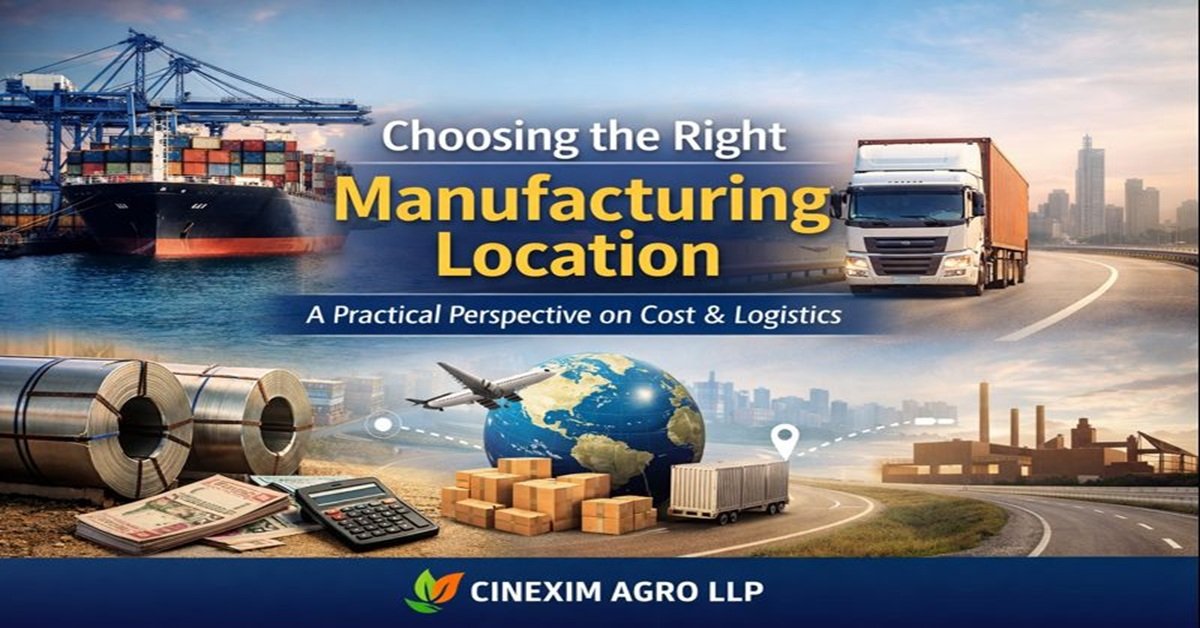
Choosing the Right Manufacturing Location: A Practical Cost and Logistics Perspective
In businesses that depend on imported raw materials and serve both domestic and international markets, logistics is not just an operational activity—it directly influences competitiveness and profitability. Over the years, Cinexim Agro LLP, while actively engaged in export-oriented trade, has observed that many manufacturing and trading decisions fail not because of product quality or demand, but due to misaligned cost and logistics planning.
This article shares a practical decision framework that management teams should consider before finalizing a manufacturing location, especially when international markets are a key growth focus.
Import of Raw Materials Is Normal—But Distance Matters
Importing raw materials through major Indian seaports such as Nhava Sheva (JNPT), Vizag, and Visakhapatnam is a common and necessary practice for many industries. From a compliance and trade perspective, this process is well established and efficient.
From the experience and industry observations of Cinexim Agro LLP, the real challenge does not lie in importing raw materials, but in managing the inland movement that follows. When raw materials must travel long distances from ports to inland factories, logistics costs quietly become a major component of the total landed cost.
When the International Market Is the Target
For companies that aim to build a strong presence in international markets, manufacturing location must be treated as a strategic decision.
Export pricing is extremely sensitive. Even a small increase in logistics cost can affect competitiveness in global tenders and long-term buyer relationships. As seen in multiple export transactions handled by Cinexim Agro LLP, buyers often compare suppliers across regions, and pricing margins are thin.
For export-oriented businesses, proximity to ports or strong port connectivity helps in:
-
Reducing inland freight costs
-
Improving shipment timelines
-
Enhancing reliability in delivery commitments
-
Preserving price competitiveness in international markets
In simple terms, manufacturing location should follow market orientation, not convenience.
Understanding the Complete Cost Structure
Before establishing a manufacturing unit, management must look beyond factory-level expenses. A complete cost analysis should include:
-
Imported raw material cost at factory gate
-
Port handling and inland transportation expenses
-
Outbound logistics for domestic and export sales
-
Selling, distribution, and compliance costs
-
Fixed operating expenses such as land, labor, and utilities
One key insight consistently highlighted by Cinexim Agro LLP is the concept of dual logistics exposure. For export sales, logistics costs are incurred twice—once while importing raw materials and again while exporting finished goods. This cumulative effect often goes unnoticed during initial planning.
Manufacturing Cost vs Logistics Cost: A Critical Trade-Off
Inland manufacturing locations may offer advantages such as lower land costs, lower labor expenses, and local incentives. These benefits are attractive on paper and often drive early-stage decisions.
However, industry experience shows that savings at the manufacturing level can be offset—or even exceeded—by higher logistics expenses. Over time, this affects:
-
Break-even volume
-
Flexibility in export pricing
-
Stability of margins during fuel or freight rate increases
In contrast, port-proximate locations may involve higher initial costs but benefit from shorter transit cycles, reduced inland freight, and improved export efficiency.
The correct decision is not about choosing the cheapest location, but about selecting the location that delivers the strongest sustainable margins.
Importance of Break-Even and Sensitivity Analysis
A location decision should always be stress-tested. Management should evaluate:
-
Impact of freight rate increases
-
Effect of minor reductions in export selling prices
-
Changes in demand volume and shipment frequency
From advisory interactions and trade planning discussions supported by Cinexim Agro LLP, it is evident that businesses with fragile cost structures struggle when logistics variables change. A resilient setup remains profitable even under moderate market pressure.
Thinking Beyond Short-Term Savings
Manufacturing location decisions are long-term commitments. Once infrastructure, supply chains, and customer contracts are established, relocating or redesigning logistics becomes expensive and disruptive.
Therefore, management should consider:
-
Future growth in export volumes
-
Long-term dependence on imported raw materials
-
Scalability of logistics and port infrastructure
-
Alignment with international expansion plans
Early alignment between manufacturing location and market strategy helps avoid structural disadvantages later.
Conclusion
Importing raw materials and managing logistics are unavoidable aspects of global trade. The real question is not whether logistics costs exist, but whether they are planned, optimized, and aligned with long-term business goals.
Based on industry insights and practical experience, including observations from Cinexim Agro LLP, manufacturing location should be viewed as a margin and competitiveness decision—not merely a cost-saving exercise. Businesses that integrate logistics thinking into their early planning are better positioned to compete, grow, and remain profitable in international markets.