
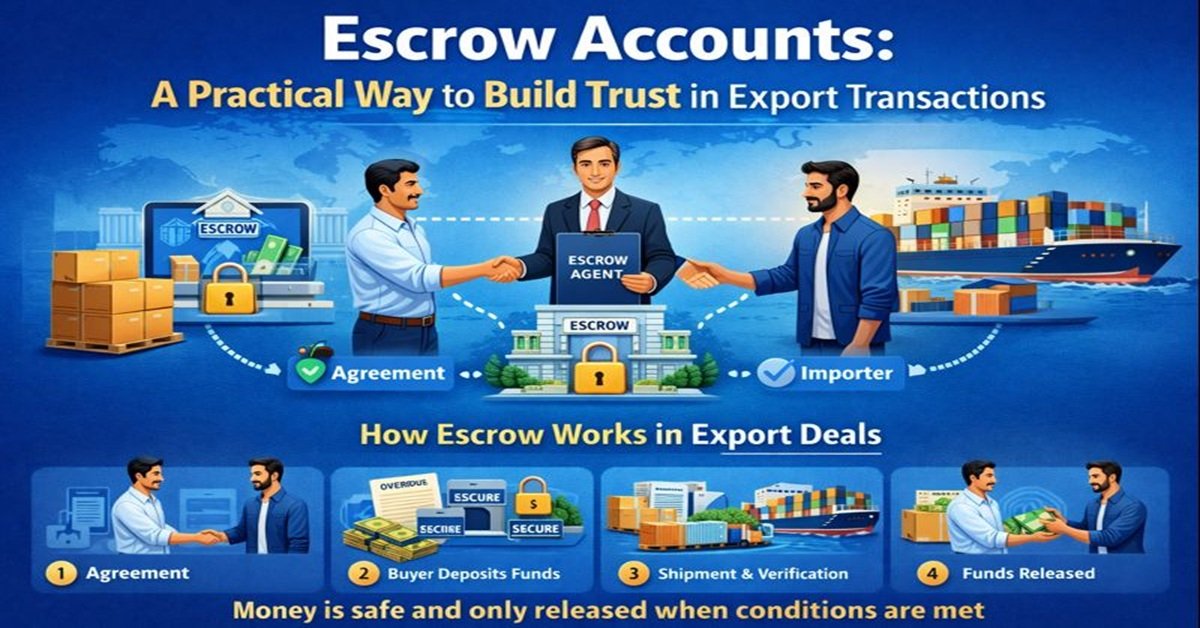
Escrow Accounts For Export
A Practical Way to Build Trust in Export Transactions
In export business trust is always the biggest challenge. Sellers worry about whether they will get paid, and buyers worry about whether they will actually receive the goods they ordered. With so much distance, paperwork, and different rules across countries, it’s not easy to feel secure. One option that can help both sides is the escrow account.
What Exactly Is an Escrow Account?
An escrow account is basically a safe place for money, managed by a neutral third party—usually a bank or a licensed escrow agent. Instead of the buyer paying the seller directly, the money goes into this account. The funds stay there until both sides have done what they agreed. Only then is the money released.
How It Works in Real Trade?
Here’s how a typical export deal might look with escrow:
- Buyer and seller agree to use escrow and set clear conditions (like delivery deadlines or quality checks).
- Buyer deposits the payment into the escrow account.
- Seller ships the consignments and provides the required documents.
- Once everything is verified, the escrow agent releases the money to the seller.
- If something goes wrong, the buyer can get their money back.
Why It Helps Both Sides?
- Exporters: You know the money is already secured before you ship.
- Importers: You don’t lose control of your funds—they’re only released when goods arrive as promised.
- Both sides: A neutral party makes sure the deal is fair, reducing disputes and building confidence.
Escrow Isn’t Very Popular Yet:
Even though escrow is safer than many people think, it’s still not widely used in export transactions. Many importers and exporters simply don’t know about it, or they stick to traditional methods like Letters of Credit (LCs).
Compared to LCs, escrow may not feel as “official” or bank‑controlled, but it’s cheaper, simpler, and flexible. For mid‑sized deals or new partnerships, it can be a very practical option.
Escrow vs Letter of Credit (LC):
Here’s a quick comparison:

In short:
- LCs are like a formal bank guarantee—secure but heavy on paperwork and cost.
- Escrow is more like a neutral safety locker—simpler, cheaper, and flexible.
Looking Ahead:
With digital trade platforms and fintech solutions growing fast, escrow accounts are likely to become more popular. Online portals and blockchain‑based systems are making escrow services easier and more transparent. For small and mid‑sized business, this cuold be a game changer. In the future, escrow might not just be an alternative—it could become a mainstream way of building trust in cross‑border trade.