
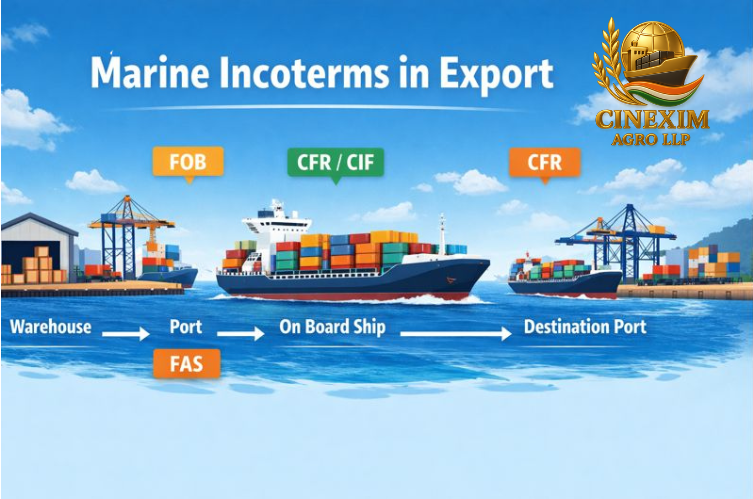
Marine Incoterms in Export: A Beginner’s Guide
India has become an active player role in global trade and the government continues to support the new exporters through various schemes and incentives. Anyone planning to enter the export business, needs a clear understanding of Incoterms, especialy those used for sea freight.
Incoterms are published by the International Chamber of Commerce (ICC) and are used worldwide in export and import transactoins. They define the responsibilities of both the exporter and a importer. For beginners, understanding marine Incoterms are essential because most bulk shipments move through sea transports.
Below are the common Incoterms used especifically for sea and inland waterway transport.
- FOB – Free on Board:
Under FOB, the exporters is responsible for delivering the goods to the port and loading them onto the vessel.
The importer books the vessel space and coordinates with the shipping line and shares the vessel details with the exporter.
Costs handled by the exporter include:
- Transport to the port
- Customs clearance
- Documentation
- Loading charges
Once the goods are loaded then the importer takes responsibility for:
- Sea freight
- Destination port charges
- Cargo clearance
FOB is a well known term but is not very rarelly used today.
- CFR – Cost and Freight:
CFR means, the exporter handles everything included under FOB and additionaly pays the freight up to the destination port.
The exporters maintain a control over the shipment until it reaches the destination port.
The Bill of Lading is a documents plays a major role here. The exporter can either:
- Send the full set of documents to the importer, or
- Surrender the Bill of Lading in India (depending on the importer’s preference)
Many importers skip insurance in CFR shipments to reduce costs, especially when shipping routes are considered safe.
- CIF – Cost, Insurance and Freight:
CIF are one of the most widely used marine Incoterms. It is similar to CFR but the exporter also arranges marine insurance for the goods.
Insurance requirements may vary based on the importers needs.
The insurance may cover:
- Road transport from the factory to the port
- Marine transport only
- Full coverage from dispatch to arrival
Buyers prefer CIF when the transit time is long or when they wants the exporters to manage risk and insurance.
Conclusion
These three Incoterms—FOB, CFR and CIF—are the most commonly used in sea transports. They help both exporters and importer clearly understand thier responsibilities, and avoid confusion. While other Incoterms exist but many are used less frequently in marine shipments.
A basic understanding of these terms helps new exporters negotiate better and manage costs and ensure smooth shipping.