
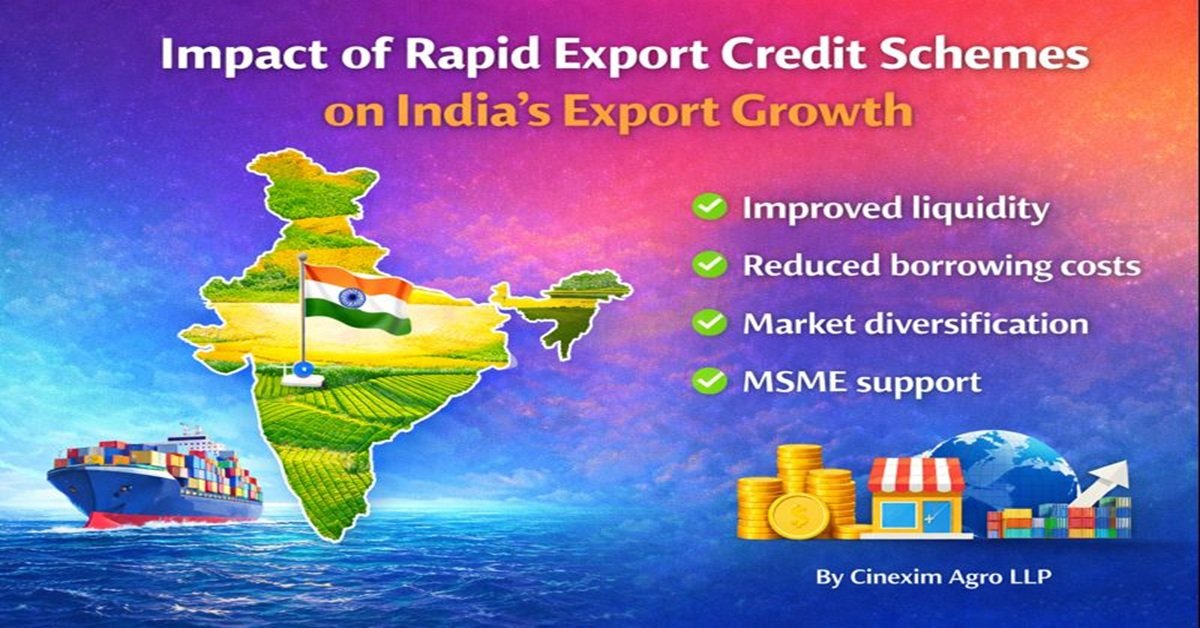
Impact of Rapid Export Credit Schemes on India’s Export Growth
Exporting goods from India to international markets requires more than just quality products. One of the most common challenges exporters face is access to timely and affordable finance. This issue is especially critical for new exporters and MSMEs, who often operate with limited capital, face collateral constraints, and experience delayed payments from overseas buyers.
To strengthen India’s export ecosystem and support businesses at every stage, the Government of India has introduced several rapid export credit schemes in recent years. These initiatives aim to improve liquidity, reduce borrowing costs, and give exporters the financial confidence needed to expand globally. At a time when global trade faces uncertainty, such credit support is playing an important role in sustaining and accelerating India’s export growth.
Companies like Cinexim Agro LLP, actively engaged in agricultural and value-added exports, are witnessing how structured export finance can help businesses scale operations, explore new markets, and compete more effectively in international trade.
- Strengthening liquidity support for exporters
Managing cash flow remains a major challenge in the export business. Exporters must arrange funds for raw materials, processing, packaging, transportation, and export documentation well before receiving payments from foreign buyers. Rapid export credit schemes help bridge this gap by providing timely working capital through banks, often supported by government guarantees. This improved liquidity allows exporters to fulfil orders smoothly without operational disruptions. For agro-exporters like Cinexim Agro LLP, such support ensures uninterrupted sourcing and timely shipment of goods to global destinations.
- Reducing the cost of export finance
High interest rates can significantly reduce export profitability and make Indian products less competitive in global markets. Export credit schemes offering interest subvention help lower the effective cost of borrowing for exporters. This reduction enables businesses to price their products more competitively while maintaining sustainable margins. For exporters handling seasonal agricultural commodities, lower finance costs help manage storage, processing, and logistics expenses more efficiently throughout the export cycle.

Government export finance support for India’s export growth
- Enabling new exporters to enter global markets
First-time exporters often face difficulties in accessing bank finance due to limited credit history and lack of collateral. Rapid export credit schemes address this challenge by offering credit guarantees and collateral-free lending options. This support gives new exporters the confidence to enter international markets without excessive financial pressure. With structured financial backing, new exporters can focus on understanding overseas demand, meeting quality standards, and building long-term buyer relationships, rather than worrying about funding constraints.
- Supporting gradual and sustainable export growth
Export credit schemes are designed not only to support entry into exports but also to encourage long-term, sustainable growth. Reliable access to working capital enables exporters to accept larger orders, plan repeat shipments, and invest in better infrastructure and compliance systems. Over time, businesses can move from small trial exports to consistent international trade operations. This steady growth strengthens India’s export ecosystem and enhances its reliability in global supply chains.
- Increasing MSME participation in exports
MSMEs form the backbone of India’s production and manufacturing capacity, yet many struggle to scale exports due to financial limitations. Rapid export credit schemes reduce lender risk and make it easier for MSMEs to access bank finance. With better funding, MSMEs can improve product quality, upgrade packaging, obtain necessary certifications, and meet international standards. Increased MSME participation not only boosts export volumes but also enhances the quality and diversity of India’s export offerings.
- Encouraging market diversification and risk management
Access to stable export finance encourages exporters to explore new and emerging international markets instead of relying solely on traditional destinations. Market diversification reduces business risk and improves long-term stability. Export credit support allows exporters to invest in market research, international marketing, and compliance requirements for different regions. Companies like Cinexim Agro LLP leverage such financial strength to expand into multiple markets, reducing dependency on any single geography.
- Strengthening trust and long-term buyer relationships
Timely delivery and consistent product quality are essential for building trust with international buyers. Export credit schemes ensure that exporters are not constrained by financial delays during production or shipment. This reliability strengthens India’s reputation as a dependable trading partner. Over time, strong buyer relationships lead to repeat orders, long-term contracts, and stable export growth.
- Overall impact on India’s export growth
By improving liquidity, reducing finance costs, supporting new exporters, and increasing MSME participation, rapid export credit schemes play a crucial role in India’s export growth. These initiatives help exporters remain competitive despite global uncertainties and rising operational costs. When exporters are financially secure, they can focus on innovation, quality improvement, and market expansion. With responsible exporters like Cinexim Agro LLP aligning their operations with these schemes, India’s export ecosystem becomes more resilient, inclusive, and future-ready.