
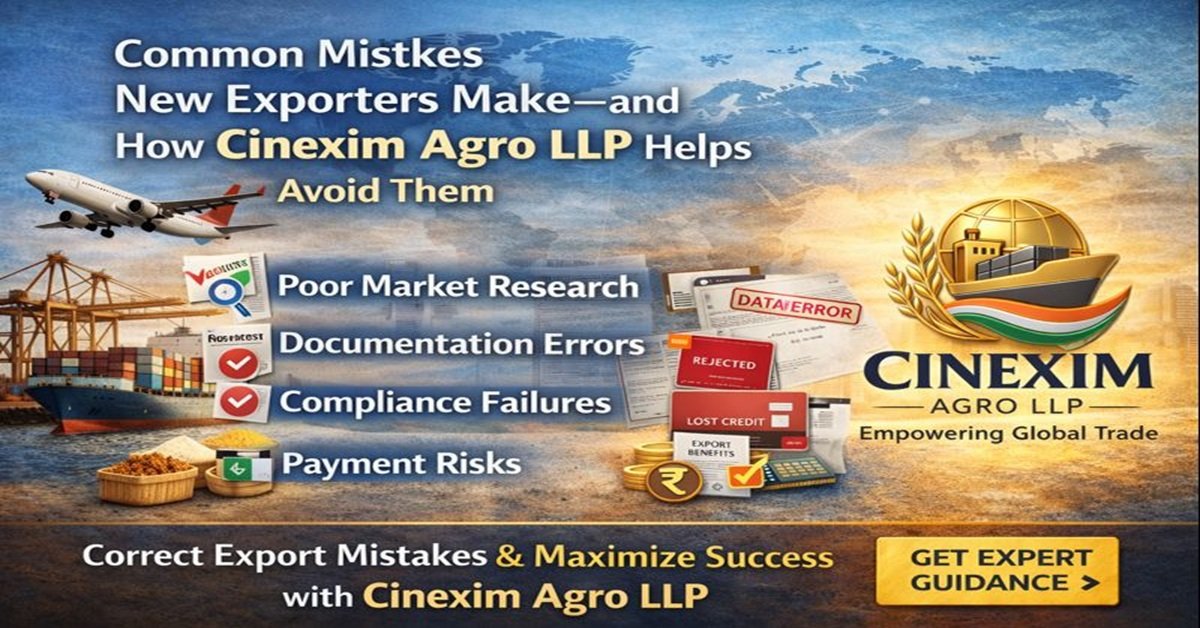
Common Mistakes New Exporters Make – and How Cinexim Agro LLP Helps Avoid Them
Starting an export business is an exciting step. Access to global markets, better pricing opportunities, and long-term growth potential make exporting an attractive option for many Indian businesses. However, for new exporters, the international trade ecosystem can be complex. A lack of experience often leads to avoidable mistakes that result in financial loss, shipment delays, or damaged business credibility.
Understanding these common mistakes—and knowing how to address them early—can help new exporters build a strong and sustainable export operation.
- Entering International Markets Without Proper Research
One of the most frequent mistakes made by new exporters is selecting export destinations without conducting thorough market research. Many exporters rely on assumptions or limited online information instead of structured analysis.
What This Leads To:
- Poor product demand in the target country
- Incorrect pricing due to unaccounted duties and competition
- Difficulty finding reliable buyers
Export-focused companies like Cinexim Agro LLP, engaged in agricultural exports, place strong emphasis on understanding market demand, import regulations, and buyer preferences before entering new regions. This approach helps reduce commercial risk and improves success rates.
- Errors in HS Code and Product Classification
Incorrect HS code selection is a technical but common mistake among first-time exporters. Even small classification errors can have serious consequences.
What This Leads To:
- Wrong customs duty calculation
- Rejection of export incentive claims such as RoDTEP
- Customs clearance delays and penalties
Proper product classification ensures smoother customs clearance and accurate incentive eligibility.
- Poor Documentation Management
Export documentation is the backbone of international trade. New exporters often underestimate its importance or rely on incomplete formats.
Commonly affected documents include:
- Commercial invoice
- Packing list
- Bill of lading
- Certificate of origin
- Phytosanitary certificates (for agricultural exports)
What This Leads To:
- Shipment delays
- Non-payment under Letter of Credit transactions
- Disputes with overseas buyers
Experienced exporters like Cinexim Agro LLP understand that accurate documentation is not just a formality—it directly affects payment security and buyer trust.
- Ignoring International Quality and Compliance Standards
Many exporters focus only on domestic quality norms, unaware that international markets often follow stricter safety, labeling, and traceability requirements.
What This Leads To:
- Shipment rejection at destination ports
- Buyer complaints and cancellations
- Long-term reputational damage
For agricultural exporters, non-compliance with SPS norms or traceability systems can even result in permanent market restrictions.
- Taking Unsecured Payment Risks
New exporters sometimes agree to risky payment terms in order to secure buyers quickly. This includes shipping goods without adequate safeguards.
What This Leads To:
- Delayed export proceeds
- Bad debts
- Complete non-recovery of payments
A clear understanding of Incoterms, payment methods, and export credit protection is essential to avoid such losses.
- Underestimating Export Costs and Logistics
Another common mistake is incomplete costing. Freight charges, port handling, insurance, inland transport, and currency fluctuations are often overlooked.
What This Leads To:
- Reduced or negative profit margins
- Pricing disputes with buyers
- Contractual failures
Accurate costing ensures exporters remain competitive without compromising profitability.
- Missing Government Export Benefits
India offers multiple export incentive schemes and financial assistance programs. However, many new exporters fail to utilize them due to lack of awareness or incorrect application procedures.
What This Leads To:
- Higher operational costs
- Loss of incentives like RoDTEP (typically 0.5% to 4.3% of FOB value)
- Missed subsidies for trade fairs, certifications, and infrastructure
Export-oriented businesses such as Cinexim Agro LLP actively monitor policy updates to ensure eligible benefits are not missed.
- Trying to Manage Everything Without Expert Guidance
Many first-time exporters attempt to handle documentation, compliance, logistics, and scheme applications on their own. While this may seem cost-effective initially, it often results in repeated mistakes.
What This Leads To:
- Delays and rejections
- Compliance failures
- Loss of time and business focus
Professional guidance helps exporters avoid these issues and concentrate on building buyer relationships and expanding markets.
How Cinexim Agro LLP Supports Exporters
As a company engaged in agricultural exports, Cinexim Agro LLP understands the practical challenges faced by new exporters. Through hands-on experience in export procedures, compliance requirements, and international trade operations, the company emphasizes structured planning, accuracy, and regulatory adherence.
By focusing on correct documentation, market understanding, and scheme awareness, exporters can significantly reduce risks and operate more confidently in global markets.
Conclusion
Most export failures do not occur due to poor products, but due to avoidable operational and compliance mistakes. Inadequate research, documentation errors, payment risks, and lack of guidance can quickly turn export opportunities into costly setbacks.
For new exporters, learning from industry experience and following proven export practices—supported by export-focused businesses like Cinexim Agro LLP—can help build a reliable, compliant, and profitable export operation. With the right approach from the beginning, exporters can avoid common pitfalls and create a strong foundation for long-term global growth.